

Hammered into Memory
Unlike most stories of this kind, this one can be verified down to the last comma. There is the text of the Central Executive Committee's resolution of November 12, 1923, a 1955 decree, atlases, stamps, newsreels and original photographic negatives from 1945. So what is much more interesting is not whether the star was there — it was — but why so many people confidently remember something that never happened, and why the “Mandela Effect” explains essentially nothing.
JUST ANOTHER POST
The debate was sparked by a post that opened with the words “A new Mandela Effect has emerged” and asked when a star had appeared above the hammer and sickle. A few days later, the story was picked up by the media, turning a private discussion on X into a public talking point.
Psychologists have been studying this mechanism since the 1970s. Elizabeth Loftus, one of the best-known researchers into false memories, explained in an interview with NPR that introducing false information about something a person has experienced can “distort, contaminate or change their memory.”
It is also worth considering who actually takes part in these discussions. It is not the entire audience that comments, but primarily those who find the question surprising. Someone who remembers the star is likely to scroll past: there is little point in arguing over something obvious.
THE FLAG
To understand where the confusion came from, we need to go back to the period before the Soviet Union was established. The first Constitution of the Russian Soviet Federative Socialist Republic (RSFSR), adopted in 1918, described the national flag as a red banner with the gold letters “R.S.F.S.R.” in the upper corner next to the flagpole, with no hammer, sickle or star. So the claim that the Soviet flag once had no star is not entirely without foundation, but it applies to the flag of a formally different state.
By then, however, the star had already become one of the most recognizable symbols of the new regime. From 1918 onwards, the red five-pointed star served as the emblem of the Red Army. Long before it appeared on the national flag, soldiers wore it on their caps, Budenovka helmets and sleeve insignia.
When the USSR was established on December 30, 1922, the treaty creating the Union merely stated that the new state had a flag, coat of arms and seal, without specifying what they looked like. The first attempt to describe the flag came at the second session of the Central Executive Committee of the USSR on July 6, 1923. In adopting the Basic Law, the session defined it as a red or scarlet banner bearing the national coat of arms. The star was present only indirectly: it crowned the coat of arms. This version of the flag remained in use for about four months and was hardly ever produced, leaving virtually no trace in popular memory.
On November 12, 1923, the third session of the Central Executive Committee amended Article 71 of the Constitution. Under the new wording, a gold hammer and sickle were to appear in the upper corner next to the flagpole, with a red five-pointed star edged in gold above them. The flag's proportions were set at 1:2. The most important point for the current debate is that the star entered the official description of the flag at the same time as the hammer and sickle, in the very same sentence of the law.
During those same decades, the star was quite literally everywhere in Soviet life. Ruby stars had shone above the Kremlin towers since 1937; a star crowned the state emblem; and by the mid-1950s, stars had appeared on the flags of all the Union republics, including the RSFSR. Perhaps that is why social media users found it so easy to “forget” it: when you see a symbol constantly, you eventually stop noticing it.
KHALDEI'S TABLECLOTHS
One of the most frequently cited arguments in the debate was a photograph of the flag raised over the Reichstag. This example deserves a closer look because the image most people have in mind actually conceals two different flags.
The first was raised over the Reichstag on the night of May 1, 1945. It was the assault flag of the 150th Rifle Division, later known as the Victory Banner. Since it was made after the design of the national flag, its upper corner next to the flagpole featured the hammer, sickle and star, as required.
The second flag appeared in the photograph that became a symbol of victory, the image most people mean when they talk about the “flag over the Reichstag.” It was made by Yevgeny Khaldei, a TASS war correspondent. Back in Moscow, he had bartered three red calico tablecloths from the photo archive's quartermaster for two bottles of vodka. He then cut a hammer, sickle and star out of white fabric and sewed them onto the cloth. On the morning of May 2, Khaldei climbed onto the roof of the Reichstag, positioned soldier Alexei Kovalyov in the frame and, according to the photographer's daughter, asked him to lean in such a way that all three symbols, including the star, would stand out clearly against the panorama of Berlin.
Before publication, retouchers added smoke to the background. The original, unretouched negative is kept at the Jewish Museum and Tolerance Center, which means the two versions can be placed side by side and compared.
WHY THE BRAIN ERASES THE STAR
From the perspective of cognitive psychology, the mass “forgetting” of the star can be explained by three mechanisms, each of which has been described and experimentally tested for decades.
The first is that familiar things are the hardest to remember accurately. Back in 1979, Raymond Nickerson and Marilyn Adams showed that Americans could not correctly draw a one-cent coin, even though they handled one almost every day. In 2015, psychologists at the University of California, Los Angeles, asked 85 students to draw the Apple logo from memory. Only one got it right. Fewer than half of the participants could even recognize the correct version among several similar ones, although most had rated their memory highly before the test. The researchers concluded that memory is designed to discard the details of familiar symbols when simply recognizing them is sufficient for everyday life.
University of Chicago psychologist Wilma Bainbridge put it this way: “We don't store everything we see in memory.” The brain, she explained, has to conserve time and energy by relying on efficient shortcuts.
Russian specialists describe the process in much the same way. Clinical psychologist Irina Pirogova told Gazeta.Ru that the brain tries to use as little energy as possible, which is why we often perceive and relay information in a distorted form. Memory relies on a template, a stable neural connection; but, as she explained, this template “can sometimes replace an actual memory, while the brain fills in facts and events with other details.”
The third mechanism explains why people make the same mistake collectively rather than individually. In 2022, Dipasri Prasad and Wilma Bainbridge published a study in Psychological Science on what is known as the visual Mandela Effect. Out of 40 familiar images, participants consistently misremembered seven — and, more importantly, they made the same mistakes. C-3PO (Threepio) from Star Wars seemed to them to be entirely gold, although one of his legs is silver. Pikachu's tail appeared to have a black tip, while the Monopoly mascot seemed to be wearing a monocle that he had never had. A follow-up study involving 389 participants in 2024 confirmed these findings, although the causes of the errors vary. Bainbridge herself acknowledges that the effect has been reproduced in a wide range of experiments, but says that “there is no single clear explanation for it” and that future research will have to establish why it happens. For example, C-3PO is usually shown from the waist up in the media, so the brain fills in the legs according to a general rule. The star on the flag, meanwhile, is “optional” to its overall meaning and is often lost when the image is simplified.
There are also some very practical reasons for the confusion. In small images, faded photographs and poor-quality newspaper prints, the star loses contrast and merges with the background. And flags rarely hang perfectly flat. Among the explanations offered by the participants themselves was the observation that in many historical photographs the cloth is folded, and the star ends up hidden in a crease. The hammer and sickle are larger and take up more space, so they are less likely to disappear in the folds. It turns out that many people really did see the flag without a star. Only it was not an alternative reality, but an unfortunate camera angle.
MANDELA AND YELTSIN
The term “Mandela Effect” was coined not by a psychologist or academic researcher, but by Fiona Broome, a writer who described herself as a paranormal researcher. In 2009, at the Dragon Con science fiction convention in Atlanta, she discovered that she was not alone in “remembering” Nelson Mandela's death in prison in the 1980s — complete with news reports, a speech by his widow and the riots that supposedly followed. In reality, Mandela was released on February 11, 1990, went on to become president of South Africa and died on December 5, 2013. Broome created a website where people could share similar “memories.” She firmly rejected false memory as an explanation and leaned towards theories involving parallel realities.
The debate over the star is a product of an age in which images have become cheaper and more accessible than ever. Logos, flags and newsreel footage are constantly being reassembled in memes, stylized versions and AI-generated images, with simplified copies gradually displacing the originals. As a result, when people finally see the original again after a long break, it can start to look like a fake. Dipasri Prasad, a co-author of Bainbridge's study, warned in an interview with National Geographic that misinformation, “especially when repeatedly presented as truth,” can indeed generate false memories.
Perhaps the most unsettling thing about this story is that people trust a vivid memory more than a document. For many, it is easier to imagine that reality itself has changed than to admit that they were wrong.
Over the USSR's 68-year existence, its flag did change: in 1923, the composition of its symbols was altered; in 1924, 1936 and 1955, their shape was modified; and in 1980, the reverse side was changed. But the star above the hammer and sickle remained exactly where it was. What changed was how carefully we look at things we have seen a thousand times.
University of Plymouth experimental psychology professor Tim Hollins, as reported by TechInsider, identifies several mechanisms behind the Mandela Effect. People remember information but forget where it came from. Wanting to belong to a group, they adopt the group's opinion, even when it is wrong. Finally, information received after an event can distort the original memory. Hollins explains the popularity of parallel-universe theories by the fact that people who embrace them find it easier to trust their own memories. In this sense, the “old Earth” is a way of preserving faith in one's memory: if I couldn't have been wrong, then the world must have changed.
Of course, advocates of alternative theories could argue that everything described above only reinforces their position. If reality really has shifted, then the Central Executive Committee's resolutions, the atlases, Khaldei's negatives and all the known laws must have been “rewritten” along with it. In that case, the consistency of the documents proves not that archives are reliable, but how carefully whoever replaced them did the job.
Still, perhaps the people who came from the “old Earth,” as the original post's author put it, really have no flags with stars. But isn't that the ultimate proof? Psychologists will, of course, continue talking about mental templates and conformity, while historians sort through resolutions by date. But, for the sake of a simpler explanation, let us assume that somewhere there probably is a universe in which there was never a star above the hammer and sickle, and millions of its former inhabitants simply woke up one day somewhere else.
Maksim Krylov
Translated from Russian by Elizaveta Ovchinnikova
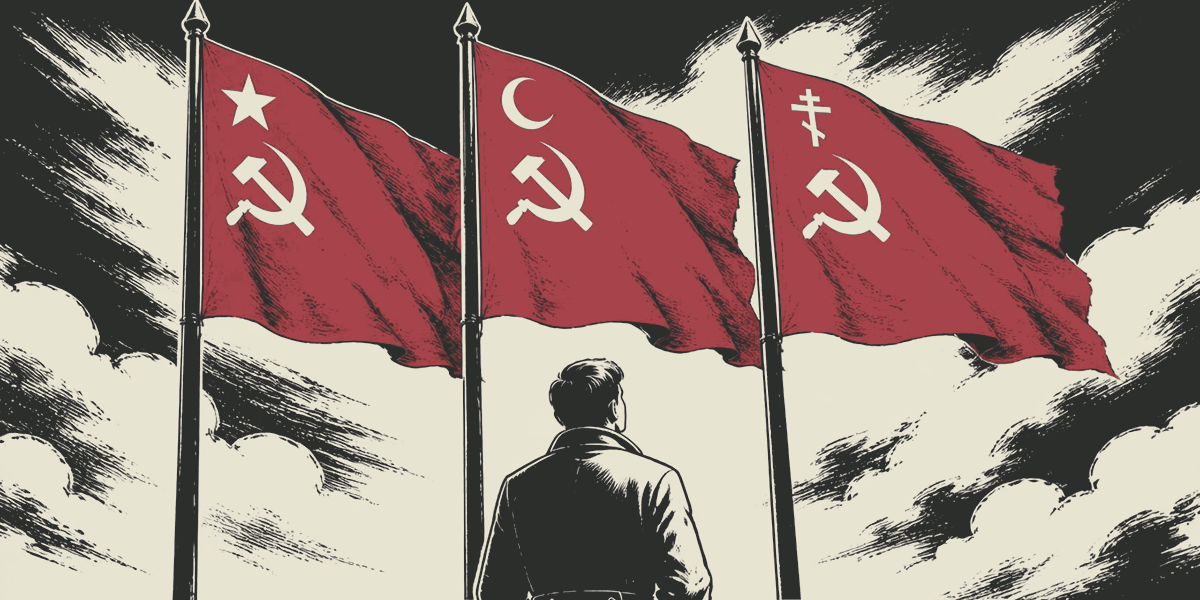
Image credit: "Za Rubejom", Leonardo.ai
Companies are increasingly assigning entry-level tasks to AI systems in order to cut staffing costs. But where will the professionals of tomorrow come from if it is already becoming harder for newcomers to land their first jobs?
An interview with Alexey Kupriyanov, Head of the Centre for the Indian Ocean Region at the Primakov National Research Institute of World Economy and International Relations (IMEMO), Russian Academy of Sciences.

Companies are increasingly assigning entry-level tasks to AI systems in order to cut staffing costs. But where will the professionals of tomorrow come from if it is already becoming harder for newcomers to land their first jobs?
In Shenzhen, participants agreed to facilitate trade and open up new business opportunities, while Putin, Trump and Xi Jinping sat down at the same negotiating table for the first time.
Brazil and Argentina have turned Spain into a battleground. Each wants its preferred candidate to become the country's prime minister.
A documentary about American con artist Elizabeth Holmes has become a global sensation.