


A Proxy War, Iberian-Style
“AN UNBEARABLE DICTATOR”?
Perhaps the most striking example of the Brazilian-Argentine “proxy war” came in November. On November 4, Argentine President Javier Milei made another trip to Madrid, his eighth since taking office.
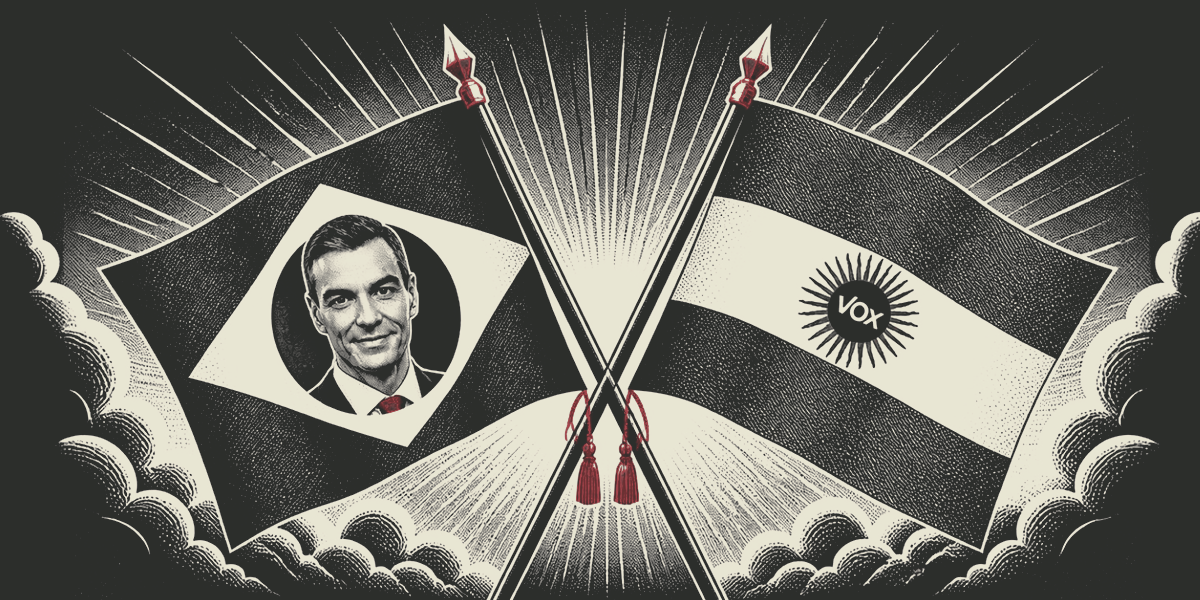
Officially, he was attending the 30th Ibero-American Summit. In reality, he had flown in to meet Santiago Abascal, leader of the far-right Vox party. Milei went straight to see him from the airport, even skipping the summit's opening ceremony and the official gala dinner at the Royal Palace.
In fact, the Argentine president had arranged his schedule specifically to avoid crossing paths with Spain's left-wing Prime Minister Pedro Sánchez. The two only came face to face on November 5, during the summit's plenary session. Spanish media described their interaction as a “frosty greeting”: Milei managed little more than a brief handshake and did not even look his counterpart in the eye. Just a second earlier, however, he had warmly greeted Spain's King Felipe VI at length.
On November 13, Milei once again entered the political fray in Spain. He recorded a full video message expressing his support for Vox in general and its leader, Abascal, in particular. He called the politician a “dear friend” and “a man of honor” who should lead the country. As for Prime Minister Sánchez, Milei believes he should be ousted as soon as possible. Official Madrid viewed the address as an open interference in the country's affairs.
OR A “PROGRESSIVE LEADER”?
Lula da Silva's visits to Spain have been an entirely different story. The Brazilian president arrived in the country on an official visit on November 16, just days after Milei's controversial remarks.
His schedule was the exact opposite of his Argentine counterpart's. While Milei did everything he could to avoid meeting Sánchez, Lula made a point of visiting the Spanish prime minister at his official residence, the Moncloa Palace. The result was hugs, a phone-camera photo session, a joint press conference and a half-hour conversation. Lula da Silva even signed a T-shirt bearing the logo of Sánchez's election campaign. The following day, the Spanish prime minister proudly showed it off at a campaign rally in Albacete.
During their private meeting, the two leaders discussed practically everything: Lula's electoral comeback in Brazil, wages, taxes and housing issues, the regulation of digital platforms, and reform of the UN Security Council. Milei also came up in their conversation. He was cited, alongside Trump, as an example of “far-right figures who threaten democracy.” Lula da Silva also described his Spanish counterpart as a “leader of progressive forces” and offered him some advice: “Pedro, you must win.”
It is worth noting that Lula da Silva had originally been scheduled to attend the Ibero-American Summit as well. However, he canceled the trip while recovering from an exhausting election campaign back home. During his visit, the Brazilian president had hoped to speak at one of Sánchez's campaign rallies but was unable to do so because he had lost his voice. Instead, he brought along an entire team of political strategists. Among them was André Janones, who helped Lula win re-election as president of Brazil and is now expected to help Sánchez hold on to his premiership.
Sánchez himself also invoked Lula's example as proof that the left can win against the odds. According to the Spanish prime minister, the Brazilian's “epic” comeback shows that “when the left believes it can win, despite unfavorable forecasts and opinion polls, it ultimately manages to do so.”
A CONFLICT THE SIZE OF LATIN AMERICA
Brazil and Argentina did not choose Spain as the arena for this unofficial political duel by chance. Spain is not simply a European country with a left-wing government. It is a historical and cultural bridge between Europe and Latin America, the host of the annual Ibero-American Summit, and a country with traditionally strong political ties to South American elites.
For Milei, Spain is a platform from which to legitimize an “international far-right movement.” He openly supports Vox, and his visits to the country coincide with election cycles, including the 2024 European elections and Spain's 2026 elections. Bloomberg noted back in 2024 that Milei “claims credit for the success of right-wing forces in EU elections.” For Lula, Spain offers an opportunity to strengthen the axis of progressive governments — Brazil, Spain and Uruguay, where left-wing politician Yamandú Orsi is also in power — and give Sánchez some much-needed symbolic support.
In Venezuela, Milei advocated a hard line toward Nicolás Maduro's government and criticized Lula for seeking diplomatic solutions. Brazil responded by refusing to represent Argentina's interests in Caracas, leaving the Argentine embassy without diplomatic cover.
IT'S PERSONAL
Naturally, the personal relationship between the two leaders has a major impact on Brazil's and Argentina's policies toward each other and third countries. Milei, for instance, has spoken of his Brazilian counterpart in extremely disparaging terms. He has called him a “thief,” a “communist,” a “crook,” a “convict” and even “socialist scum.”
Lula da Silva has refrained from stooping to quite the same level of insults, but he has not missed an opportunity to take a jab at his opponent, either. On one occasion, he called Milei “a man who talks nonsense.” In response to other insults, Lula chose not to mention his name, referring to Milei instead as “that thing.” On another occasion, the Brazilian president pretended not to know who he was talking about at all. When asked about Milei, Lula replied: “Who is that, anyway?”
To his credit, the Brazilian president has consistently made a point of refusing to get drawn into a war of words with Milei. “There's no point in getting angry, because I'm not going to get angry. If he pulls a face, I'll put on a kind one. If he shows hatred, I'll show love,” he said.
At the level of state relations, however, Lula's professedly conciliatory approach has proved ineffective. In August 2026, following yet another round of insults from Milei, Brazil recalled its ambassador from Buenos Aires and downgraded diplomatic relations with Argentina to the level of chargé d'affaires — “an unprecedented decision in the diplomatic history of the two countries.”
Milei, meanwhile, openly backed Lula da Silva's rival in the presidential election, Flávio Bolsonaro. After Bolsonaro lost, the Argentine president helped him flee Brazil for the United States, where he remains to this day. Milei has never recognized Lula's own victory. For Lula, this is not merely a political gesture but direct interference in Brazil's institutional processes. For Milei, in turn, the conflict with Lula is a way to strengthen his position within his own right-wing coalition.
BACK TO SPAIN...
The Spanish elections scheduled for November 29 are set to be no less fiercely contested than the Latin American “proxy war.”
Sánchez called an early election in October after parliament rejected two government decrees concerning the housing crisis. He hoped a short campaign focused on the economy and housing (issues traditionally popular with left-wing voters) would turn the tide. However, the campaign was overshadowed by a railway disaster in Urde that claimed at least 69 lives, as well as the right's consistently strong showing in opinion polls.
Sánchez's Spanish Socialist Workers' Party (PSOE), despite gradually improving its ratings during the campaign, from 25.3% to 30.3%, is still trailing and could win between 102 and 133 seats, depending on the poll. To the left of the PSOE is a fragmented left-wing camp, including the Frente Amplio (a coalition comprising Podemos and United Left) and regional parties. However, they are not enough to make up for the Socialists' shortfall.
Spain is therefore highly likely to end up with a right-wing government formed by the PP and Vox. Sánchez, even with Lula's symbolic support and the “comeback effect,” is unlikely to repeat the Brazilian miracle. As things stand, Milei, who has placed his bets on Vox, has a better chance of celebrating victory on European soil.
Regardless of the outcome of the November 29 vote, however, the mere fact that the presidents of Brazil and Argentina felt compelled to fly to Madrid in person in the middle of another country's election campaign speaks volumes. The ideological confrontation between the two Latin American giants is no longer a regional dispute. It has become part of a global struggle over what the West's political landscape will look like in the next decade, and Spain has emerged not as a sideshow, but as one of its main stages.
Vitaly Ryumshin
Translated from Russian by Elizaveta Ovchinnikova
Image credit: "Za Rubejom", Leonardo.ai
An interview with Pavel Plechov, Doctor of Geological and Mineralogical Sciences and Professor of the Russian Academy of Sciences.
Companies are increasingly assigning entry-level tasks to AI systems in order to cut staffing costs. But where will the professionals of tomorrow come from if it is already becoming harder for newcomers to land their first jobs?

Companies are increasingly assigning entry-level tasks to AI systems in order to cut staffing costs. But where will the professionals of tomorrow come from if it is already becoming harder for newcomers to land their first jobs?
In Shenzhen, participants agreed to facilitate trade and open up new business opportunities, while Putin, Trump and Xi Jinping sat down at the same negotiating table for the first time.
“How very touching — the hammer and sickle, and the star…”, as sung in an iconic song by the late-Soviet punk band Grazhdanskaya Oborona. But was there a star on the Soviet flag? And what does this debate tell us about our memory?
A documentary about American con artist Elizabeth Holmes has become a global sensation.