

Disorder of the Day
BARRICADES REPLACE CAFÉ TABLES
On Saturday, October 17, a peaceful march against high prices ended in clashes near Milan Cathedral. Masked demonstrators built barricades out of tables from Milanese cafés, threw stones and chunks of paving at police officers, ransacked shops and set up barricades ablaze. Police responded with water cannon and tear gas.
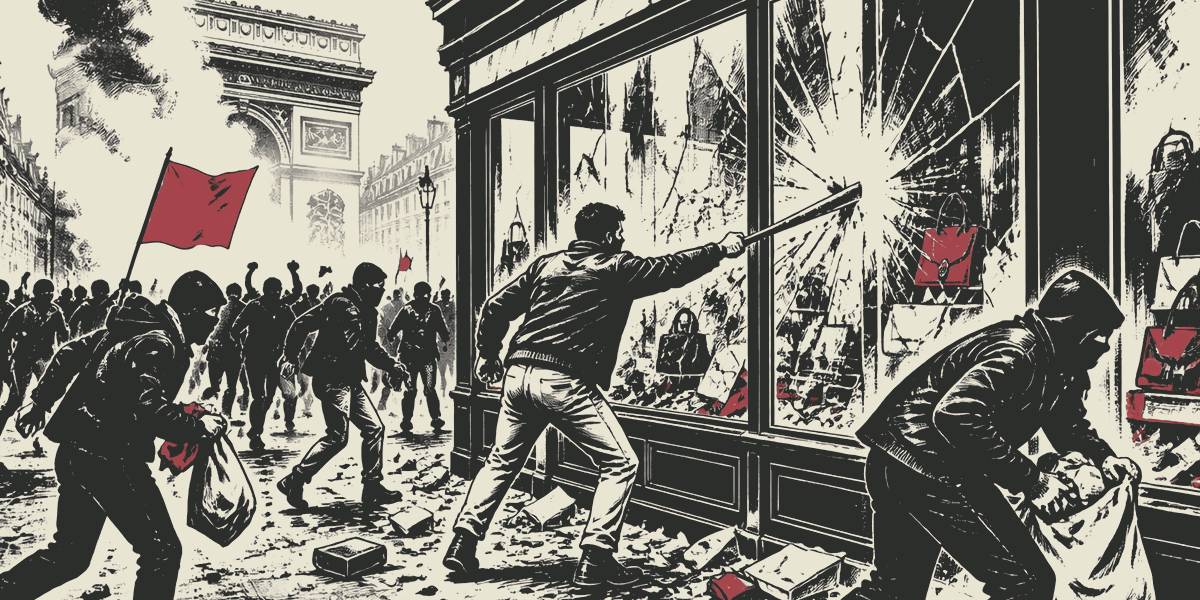
Following Sunday's clashes in Milan, 271 people were taken to police stations, including 220 minors. Thirty-two people were arrested. Meanwhile, riots also broke out in Turin and Bologna.
As young people told Corriere della Sera, some participants had been lured into the city centre by promises of free clothing. In messaging chats, they initially discussed rising prices, but invitations soon began circulating: “Come to the Duomo. We'll smash the shop windows, and you can take the trainers, hoodies and bicycles.”
The unrest had consequences beyond arrests and detentions. On October 20, Giorgia Meloni's government approved measures introducing new penalties for violence at demonstrations and requiring parents to compensate victims for damage caused by their underage children. In addition, 500 military personnel are to be deployed to Milan to support the police. “A new criminal offence is being introduced for violence during protests,” Meloni said in a social media video after the decree was approved.
A video from Nice has attracted millions of views. It shows the manager of a Micromania video game shop trying to stop looters. Pierre Collin was on holiday, but rushed to the shop after receiving a call from a former employee and took up position at the entrance. Protesters threw stones at him before one of the attackers kicked him in the back. He fell onto broken glass but managed to get back to his feet.
The shop was looted nonetheless. In a photograph that spread across social media, Collin stands beside a poster of Goku, the hero of the Dragon Ball manga series. Users dubbed the manager the “French Goku”, created superhero-themed illustrations of him and posted messages of support.
In the wake of the riots, Prime Minister Sébastien Lecornu proposed imposing curfews in certain areas. Interior Minister Laurent Nuñez offered his resignation, but President Emmanuel Macron refused to accept it.
WHAT THE STREETS ARE DEMANDING
At the same time, southern Italy saw protests by road hauliers demanding government assistance over soaring diesel prices. Fuel now costs roughly a third more than it did before the war in Iran, while a temporary fuel tax discount expired in early October. In the country's southern regions, truck drivers have even been blocking deliveries. Supermarket shelves in Naples are emptying, and petrol stations are running short of fuel. Italy's Transport Minister Matteo Salvini has promised new tax breaks and financial assistance. France, which has also faced supply disruptions through the Strait of Hormuz, has extended support for farmers and people who drive extensively for work.
In France, where the riots have been particularly widespread, several waves of discontent have converged. Protests by school students have been joined by demonstrations against the rising cost of living and the deterioration of public services. But the movement began with problems in the education system that emerged long before the fuel crisis.
At Lycée Le Corbusier, near Paris, math, English and other classes have been cancelled since the start of the school year because there are no teachers available to teach them. Seventeen-year-old Maisa told Reuters that she was preparing for her French exam without a French teacher. Another schoolgirl held up a placard reading: “Our address should not determine our future.”
The authorities have promised to recruit another 3,000 substitute teachers. Parents, teachers and trade unions have joined the school students, and demands for better education have expanded to include calls for higher wages and pensions.
In Spain, protests erupted after the case of 87-year-old Maricarmen Abascal came to light. According to a tenants' union, the rent on her Madrid flat was raised from €570 to €1,650 which is more than her pension. She was evicted and died two weeks later. Abascal's story struck a nerve in Spanish society, where the threat of losing one's home or being unable to afford the rent has become an everyday reality for many. Media estimates suggest that rents across Spain have risen by 44% over five years, while house prices have increased by 58%. During the protests, a portrait of Abascal even appeared in a tent camp in Puerta del Sol square, becoming a symbol of the fight for affordable housing.
Protests are also escalating in Albania. Initially, people took to the streets over plans to build a luxury resort next to a landscape protection area. Jared Kushner, son-in-law of US President Donald Trump, is involved in the project through his company. Students have since joined the demonstrations, demanding lower tuition fees, increased university funding and a genuine crackdown on nepotism.
Prime Minister Edi Rama acknowledges problems with the cost of living and housing, but describes the unrest as “hybrid warfare”. Some protesters are calling for his resignation. “We're tired of peaceful protests. We won't stop until Rama resigns,” student Lora shared with Reuters.
“THEY'LL MAKE A FUSS AND THEN GIVE UP”
Protests have spread beyond France, but their participants do not share a single set of demands, Andrey Yashlavsky, a lead researcher at the Primakov National Research Institute of World Economy and International Relations (IMEMO) of the Russian Academy of Sciences, told “Za rubejom”. Problems in schools, unaffordable housing and construction in protected areas are among the different grievances driving people onto the streets in different countries. The consequences of the protests, therefore, are likely to vary as well.
Yashlavsky attributes the prominent role of school and university students to young people's susceptibility to protest. He describes them as an “explosive” element that needs only a match to ignite. France also has a long tradition of student activism, stretching from the May 1968 protests to more recent demonstrations. However, it is no longer possible to regard the current protests as a movement driven exclusively by young people.
“We shouldn't assume that only young people are involved. In France, for example, their parents, grandparents and senior citizens have also joined the protests,” Yashlavsky stressed.
Natalia Eremina, a professor at Saint Petersburg State University, believes that young protesters' discontent goes beyond objections to individual politicians. “This is not about a particular head of state, but about a system as a whole that fails to reflect the values of young people, who are desperately striving for equality,” she told “Za rubejom”.
“They'll make a fuss and keep making a fuss. They may secure some concessions, some promises. But as for fundamentally changing the situation, no. It is unlikely to go that far,” the expert said.
He singles out Albania: there, the protesters are seriously determined to bring down Prime Minister Edi Rama. Yashlavsky is not yet prepared to predict whether they will succeed.
Alena Kazakova
Image credit: "Za rubejom", Leonardo.ai
An interview with Olga Veretennikova, Vice President of the Borsell analytical firm
Since the Soviet era, hundreds of thousands of Africans have studied in Russia, including future presidents and prime ministers. The new Russian-African Youth Union aims to carry this tradition forward and take it to a new level.

Since the Soviet era, hundreds of thousands of Africans have studied in Russia, including future presidents and prime ministers. The new Russian-African Youth Union aims to carry this tradition forward and take it to a new level.
Japan’s government wants to pass its own foreign agent law. Tokyo has decided to model it on the US Foreign Agents Registration Act (FARA), flaws and all.
The UN marks its 81st anniversary. These days, disagreements and funding shortages are hampering the organization’s work, but experts say it remains indispensable to preserving peace.
The festival “Africa. Together into the Future” showcased the art of the continent in all its diversity.