

Africa Beyond the Frame
The opening ceremony of the festival “Africa. Together into the Future” was held at the Central House of the Actor in Moscow. This year, guests were treated to a special programme combining contemporary African fashion, ballet and theatre. Anna Shtil, the festival’s general producer, stressed that one of its main objectives was to create a space for communication and new collaborative projects. “When I say that we are opening the festival, it is more than merely a cultural event. It is an opportunity to communicate face to face and to create new projects. I am endlessly grateful to all our friends and partners, to my team, and to everyone who has put a piece of their soul into our festival,” she said.

The evening’s artistic programme opened with a fashion performance directed by Anna Verde. A presentation of the collection by the internationally renowned African brand and art project Masa Mara was accompanied by performances from leading ballet dancers. Rwandan designer and artist Nyambo Masa Mara, the founder of Masa Mara, travelled to Moscow specifically to take part in the festival.
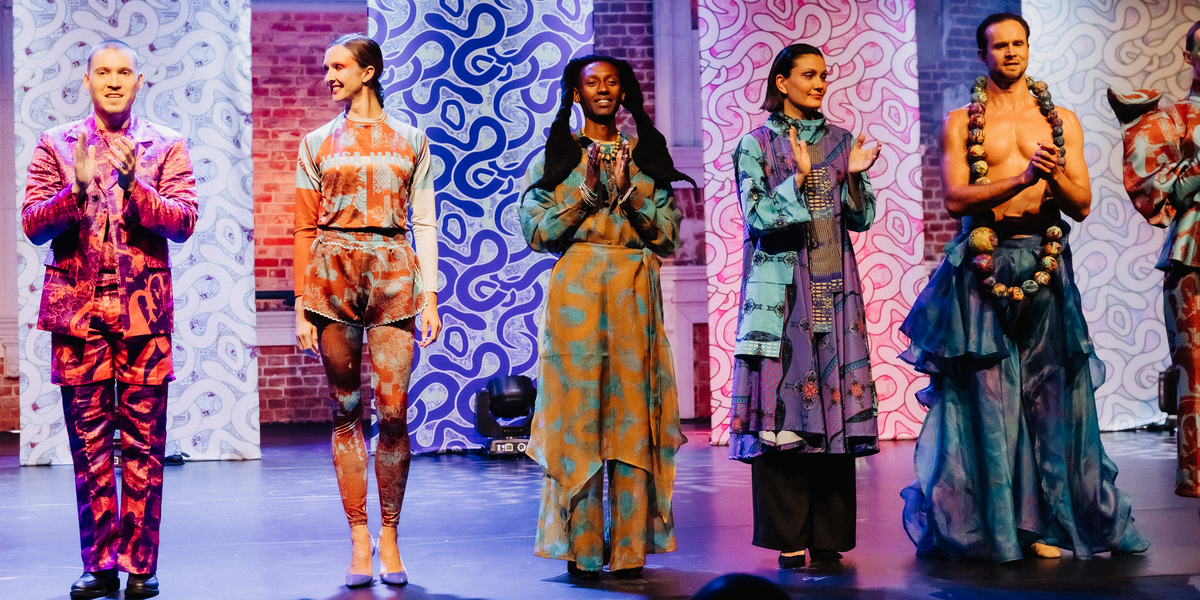
The combination of choreography and fashion runway presentation impressed even Moscow’s discerning audience. The Masa Mara collection became an integral part of the stage performance: futuristic looks, traditional African motifs and the aesthetics of modern megacities were brought to light through the movements and physical expression of the ballet dancers.
The opening programme continued with Senegalese artist and choreographer Ibrahima Niasse. He presented one of his best-known works in Moscow, the solo performance “The Rights of Nature” which combines traditional African dances with contemporary dance and hip-hop. At its heart are the relationship between humans and the world around them, and an attempt to rethink the place of nature in contemporary culture.
After the performance, Ibrahima Niasse explained the central idea behind his work: “For me, it is very important to preserve nature and leave this world for future generations. We all live in the same world, and this world belongs to all of us. We inherited it from our ancestors, and it is essential that we think not only about ourselves but also about those who will come after us.”

During the festival, round-table discussions, lectures, public talks and open debates brought together filmmakers, researchers, cultural figures and representatives of the creative industries from Russia and African countries. The programme also featured special events devoted to contemporary African fashion and design, as well as meetings with film directors, actors, producers and artists.
This year’s film programme offered an unexpected perspective on contemporary African cinema. Serious social and historical themes appeared alongside a body horror film, a mystical parable, a rap musical, and a dance film. The festival provided a rare opportunity for Russian audiences to discover some of the most exciting new works in African cinema on the big screen. These are films that are currently attracting attention at major international film festivals.
The festival also included a retrospective of Ousmane Sembène, a classic of world cinema widely regarded as the “father of African cinema.” His work played a major role in shaping the development of African filmmaking in the second half of the twentieth century.
One of the festival’s key events is “African Art Today”, an exhibition of contemporary African art. For the first time in Moscow, a single project brought together leading artists whose practices move beyond conventional narratives about Africa and present the continent from within. Opened at the State Museum of Oriental Art on October 9, the exhibition focuses on contemporary African art that reaches far beyond the continent itself. The works were selected according to one unifying criterion: they were all created in the 2020s. This approach offers a snapshot of what is happening in African art right now. The exhibition features bronze sculptures, paintings, photography, works made using individual artistic techniques, and pieces from the world of haute couture.
The project emphasises the artist’s central role in interpreting their own work. The artists themselves selected the pieces for the exhibition, and instead of curatorial commentary, the works are accompanied by quotations from interviews with their creators.
The exhibition also features a section devoted to contemporary fashion. The designers bring together tradition, craftsmanship and modern aesthetics. “These are not simply clothes. Above all, they carry meanings and cultural context. Designers often draw on textile traditions, seeking to preserve them in their work. The textile traditions of sub-Saharan Africa, in particular, have always been rich in symbols of status, belonging and cultural identity,” explained Anna Rykova, one of the exhibition’s curators, the festival’s co-producer and creative director, at the exhibition’s opening.
The continent is distinguished by the diversity of its artistic practices. At the exhibition, paintings by Barthélémy Toguo and sculptures by Siriki Ky share space with photographs by Mayowa Lawal and Harry Odunze, as well as haute couture pieces by Solome Asfaw, Eltayeb Dawelbait, Iona McCreath, Nyambo Masa Mara, Doreen Mashika and Awa Meité. Saïdou Dicko transforms the figures in his photographs into shadows through painting, while Abdoulaye Konaté creates large-scale textile panels, drawing on the tradition of using fabric as a means of non-verbal communication. Photographer Mayowa Lawal, too, finds inspiration in West African textiles.

The use of materials and techniques unconventional in classical visual art, engagement with sociopolitical and historical themes, and the search for identity are characteristic of many contemporary artists, regardless of where they were born. African art has been part of global artistic developments for decades, including the international art market. The artists featured in the exhibition are not confined to national or African contexts. They actively collaborate with museums and galleries in Europe and Asia. Many of their lives and careers have involved temporary or long-term immersion in other cultures. Abdoulaye Konaté received his art education in both Mali and Cuba. Barthélémy Toguo was born in Cameroon but studied at an art academy in Côte d’Ivoire, then continued his studies in Grenoble, France, and Düsseldorf, Germany. Burkinabè sculptor Siriki Ky honed his skills in Pietrasanta, Italy. Saïdou Dicko moved from Burkina Faso to Senegal and later to France.
We spoke with Anna Rykova, one of the exhibition’s curators, about Africa’s cross-cultural ties with Europe and current trends in fashion.
– Russian fashion often embraces European or Western influences, but does the same trend exist in African fashion?
– Practically everyone in the world wears European-style clothing. At one point, Louis XIV, a clever man, launched an entire campaign to promote luxury goods and European fashion (French fashion in particular) in neighbouring European countries and beyond. So Africans use European silhouettes in their designs but fill them with African content and meaning.
– Do we Europeans, in turn, embrace African influences?
– I would say that some elements of traditional African dress were adopted in our culture through the influence of Islam. These include voluminous dresses and tunics. We also know very well that oversized clothing remained fashionable for a long time. All of this has its roots in the traditional dress of North Africa, which later spread to West Africa as well. Furthermore, look at the latest global fashion weeks in New York, London, Milan and Paris, which wrapped up only recently. You will see a great deal of texture in fabrics and a lot of colour. These things, of course, come from the African continent. Many of the trends in fabric texture come from Africa because traditional clothing there often involves working with textiles, unfinished edges, threads and raffia. These materials create that characteristic fluffiness and tactile quality.
– Walking down the street, we sometimes recognise a distinct African influence in someone’s style, regardless of their own ethnic background. What defines African style?
– I think there is a fundamental, overarching way in which Africans perceive themselves and the world. They have no boundaries. When it comes to Europeans’ perception of time, we always have a beginning and an end. We know that we were born and that sooner or later we will die. Some people hope for a better afterlife, while others do not. In Africa, however, this concept does not exist in the same way. The limits to which we are accustomed simply are not there. In traditional African art, the kind that once caused such a stir in Picasso, there are no boundaries, no concept of the golden ratio, and no established rules governing how things should be painted or cut out. Artists do whatever they need or feel inspired to do, and they are perfectly comfortable with that. This is an absolute freedom of thought: the freedom to take a traditional material and use it in an unconventional way, or to take a rhythm and turn it into something truly extraordinary.
– At the opening, Masa Mara from Rwanda presented a show that combined a traditional runway presentation with dance. How common is this approach in fashion shows?
– Contemporary dance is not entirely typical of Masa Mara, I would say. The brand works very well with form and produces many sculptural pieces, which is why it uses fabrics that hold their shape, such as nylon. These garments are easier to appreciate when presented through relatively restrained movements. Still, there is always room for experiments. You cannot present a runway show in exactly the same way for several seasons in a row. Sometimes you need to reinvent the format.
– Is it acceptable for a man to wear a skirt?
– Absolutely. Going back to Louis XIV, European fashion was instrumental in making trousers widespread. As for Africa, just look at the Senegalese dancer at the festival. He is wearing a contemporary version of the grand boubou, a voluminous men’s tunic worn over trousers. Generally speaking, skirts and tunics are traditional forms of clothing. In village life, they are primarily related to the climate. You take a piece of fabric woven from raffia, cotton or whatever other materials are available, you wrap it around yourself, and that’s it. In terms of the garment’s basic form, there is no distinction between men’s and women’s clothing. Essentially, it is a long rectangle of fabric, which a woman wraps around herself in one way and a man in another. What really matters, as a rule, is the motifs and the patterns covering the fabric. These can tell you whether the cloth is intended for a man or a woman, what social class the person belongs to, which village they come from, whether they have children, and what other meanings the fabric carries. So yes, a skirt is absolutely normal.
The exhibition “African Art Today” is open at the State Museum of Oriental Art until November 1.
Rodion Chemonin
An interview with Olga Veretennikova, Vice President of the Borsell analytical firm
Since the Soviet era, hundreds of thousands of Africans have studied in Russia, including future presidents and prime ministers. The new Russian-African Youth Union aims to carry this tradition forward and take it to a new level.

Since the Soviet era, hundreds of thousands of Africans have studied in Russia, including future presidents and prime ministers. The new Russian-African Youth Union aims to carry this tradition forward and take it to a new level.
Japan’s government wants to pass its own foreign agent law. Tokyo has decided to model it on the US Foreign Agents Registration Act (FARA), flaws and all.
The UN marks its 81st anniversary. These days, disagreements and funding shortages are hampering the organization’s work, but experts say it remains indispensable to preserving peace.
What has brought Europeans onto the streets, and what concessions might governments make?