


Fiscal Incapacity
All this is happening in a country that has changed prime ministers seven times over the past decade, had eight chancellors of the exchequer, and promised welfare reform twice already. We look at how a system designed to help the most vulnerable has turned into a crucial means of survival for entire communities and also a political landmine that has already blown up more than one government and now threatens the next.
THE STORY OF A FRAUDSTER
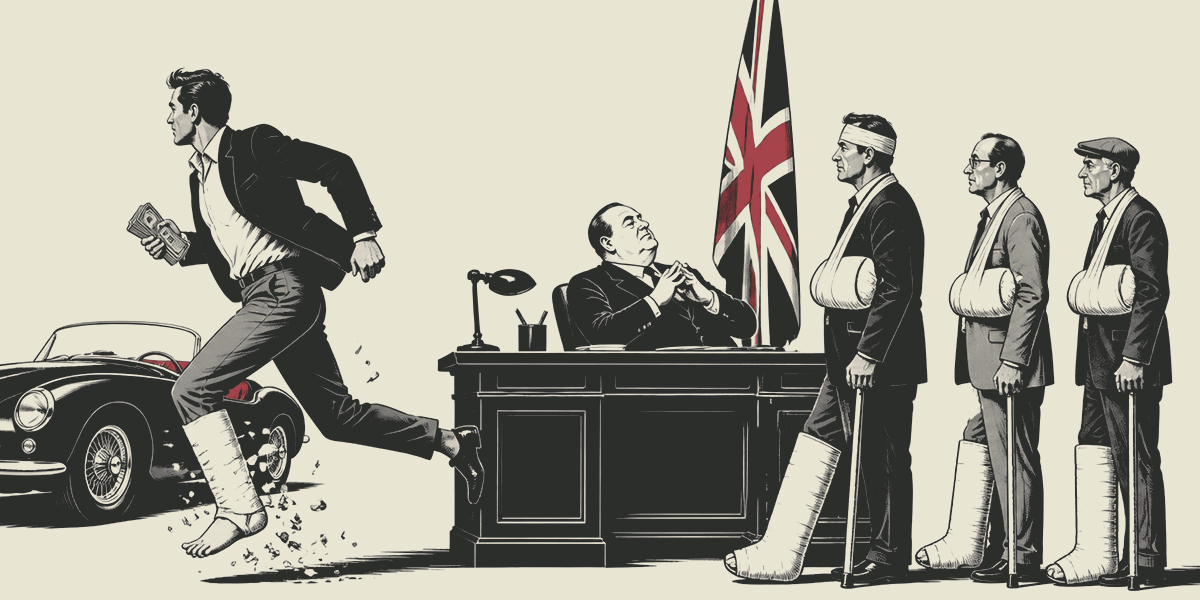
In 2021, a British woman named Catherine Wieland applied for disability benefits. She told the Department for Work and Pensions that, after suffering emotional trauma, she hardly ever left the house and struggled even with everyday tasks such as washing herself. She was awarded a benefit of around £700 a month.
What happened next is documented in court records. People receiving this kind of benefit can exchange part of it for a car through the government-backed Motability scheme. Wieland took advantage of the scheme and obtained a BMW for a small upfront payment. She drove it to hair salons and restaurants, visited Brighton and went to an amusement park. She also flew to Cancún, Mexico, and posted social media photos of herself zip-lining and riding an all-terrain vehicle.
After that, an anonymous tip-off was made about Wieland and criminal proceedings were brought against her. In early 2026, she pleaded guilty to benefit fraud. The court ordered her to repay around £23,000 but did not send her to prison. Her lawyer said that his client had not understood that someone receiving this kind of benefit was not supposed to be so active outside the home.
The Wall Street Journal opens its investigation into the use of British disability benefits with Wieland’s story. The journalists stress that hers is an extreme case and should not be taken as representative of all claimants. Even so, benefit fraud is not uncommon in the UK.
The problem is that claimants do not need to provide medical evidence from a doctor in order to receive the main disability benefit, Personal Independence Payment (PIP). They fill in a questionnaire and attend an interview, describing the everyday tasks they struggle with. Since the pandemic, these interviews have mostly been conducted by phone or video call, making it even harder to verify what applicants say. Existing claimants are rarely reassessed. Wieland herself was exposed not by an inspector but by an anonymous informant. Misconduct is also uncovered within the Motability scheme. Around 5,300 people were removed from it in a year, i.e., an average of 15 a day.
It is worth stressing, however, that fraudsters like Wieland are a minority. It is not true that the system simply hands money out to anyone who asks. In July 2026, only around 36% of new PIP claims were approved. Most benefit recipients are people with chronic illnesses, anxiety or depression, often with limited qualifications and low incomes; in many cases, they are part of families in which a child is ill.
So the problem is not so much greedy fraudsters as the fact that, for many people, benefits have become a substitute for work, and returning to the labour market can be extremely difficult.
A BUDGET THAT WON’T STRETCH FOREVER
The fastest-growing group is working-age claimants, meaning people who are expected to work and pay taxes. Their numbers have risen by more than 60% since 2019, while government spending on sickness and disability benefits has increased by a quarter over four years.
Most of the growth is in PIP. This payment is intended to help people with illnesses or disabilities cover the extra costs associated with their condition. It is not means-tested, so both poor and well-off people can receive it, whether they are employed or unemployed. By the end of July 2026, 4.09 million people in England and Wales were receiving PIP. That was a record, and the number had risen by 7% in a year. In real terms, spending on PIP increased from £16.3 billion in 2020 to £27.3 billion in 2025, which is a two-thirds rise in five years.
Mental health conditions account for the largest share of PIP claims. Some 1.6 million people, or 39% of all recipients, receive the benefit on these grounds. That is more than the number of claimants with joint, back or muscle conditions. The increase has been particularly striking in recent years: between 2017 and 2025, the number of claims related to cancer doubled, while claims related to mental health conditions quadrupled.
When the benefit from which PIP later evolved was introduced in the 1990s, the government expected it to go to a few hundred thousand people. According to the WSJ’s calculations, it now reaches roughly one in every 12 British people. Conditions that can qualify someone for the payment include anxiety, depression, ADHD and even acne.
Around 1,000 new people are awarded PIP every day. Some recipients leave the system, for example, when they retire or lose their entitlement. As a result, the total number grows more slowly, but it continues to grow. Government figures show that the number of recipients increased by 400,000 between July 2023 and July 2024, and by 260,000 between July 2025 and July 2026. The authorities describe this as a slowdown. But the number of recipients is not falling; it is simply rising more slowly than before.
For comparison, the United States has two main federal programmes for people who cannot work because of illness or disability. The first, Social Security Disability Insurance (SSDI), works like insurance: it is available to people who previously worked and paid Social Security taxes. The second, Supplemental Security Income (SSI), is intended for low-income people with disabilities who do not have a sufficient work history.
The number of SSDI recipients grew for several decades. In 1985, there were 2.7 million; by 2014, there were around 9 million. After that, growth turned into decline. By the end of 2017, the number had fallen to 8.7 million, and by 2020 to 8.2 million. There are several reasons for this. First, US authorities began approving new applications less often. Baby boomers reached retirement age and moved from disability benefits to regular retirement benefits. In addition, the labour market recovered after the 2008 crisis, making it easier for people to find work.
For the sake of accuracy, it should be noted that the WSJ comparison is not entirely fair, because the two countries’ programmes work differently. In the US, benefits go only to people deemed unable to do any substantial work for at least a year. In Britain, people can receive PIP while working, because it is intended to cover the extra costs associated with a condition rather than replace earnings.
SICKNESS, POVERTY AND COMFORT
There are three main reasons for the rise in benefit claims. All of them are operating at the same time, and none can explain the increase on its own.
First, people’s mental health really has deteriorated. Since 2019, the number of people in the UK aged 16 to 34 who are not working or looking for work because of mental health conditions has increased by 76%. These figures were cited by businessman Charlie Mayfield in the government report Keep Britain Working. A similar trend can be seen among young people who are not in education, employment or training, known in the UK as NEETs. More than a quarter of them cite illness or disability as the reason. In 2013–14, the figure was just 12%.
Alan Milburn, a former health secretary and the author of another government report, believes that social media is one of the main reasons young people have become more anxious. In his view, spending so much time online has fundamentally reshaped young people’s thinking and intensified their anxiety. At the same time, Milburn does not consider them a spoiled or lazy generation. He has also urged employers to take better care of young staff and help them adjust to working life.
Psychologist and Gestalt therapist Yegor Manyshin believes that two factors have come into play. “Young people’s mental health really has worsened, especially since the pandemic, when depressive and apathetic states became noticeably more common,” he says. “But much of what social media presents as signs of depression, attention-deficit/hyperactivity disorder (ADHD) or obsessive-compulsive disorder (OCD) is not actually any of those things. Social media broadens the boundaries of symptoms, making ordinary distress look like a diagnosis.” The expert notes, however, that there is a positive side to this phenomenon: after noticing such signs in themselves, many people do seek professional help and receive a genuine diagnosis from a qualified specialist.
Second, there are poverty and rising prices. The real wages of the lowest-paid workers are barely increasing once inflation is taken into account, while housing and utility costs continue to rise.
In the 2010s, the Conservative government cut spending on unemployment benefits. Payments were frozen for several years even as prices rose, and sanctions against claimants became stricter. For example, missing an appointment at a job centre could lead to a temporary loss of benefits. The authorities expected this to push people back into work more quickly. But the economy was growing slowly, jobs were scarce, and many people never returned to the labour market. Instead, they began claiming sickness and disability benefits. These payments are usually higher, and recipients are not forced to look for work under threat of sanctions. In the end, tightening the rules for one type of benefit did not reduce the number of people receiving state support; people simply moved on to other payments.
Third, there is the assessment process. As noted above, applicants do not need medical evidence from a doctor to receive PIP. Decisions are based on a questionnaire completed by the claimant and an interview. Not long ago, the British broadcaster Channel 4 reported on a man who spent three years unsuccessfully trying to give up his disability benefit. He had recovered from depression and informed the authorities several times, but his notifications were never processed and the payments continued.
Fourth, is there any incentive to give up benefits? Over the years, an entire industry has grown up around claiming them. Consultants and charities help people navigate the system. There is even a ChatGPT-based AI assistant called Pippin that advises applicants on how to fill in the form. TikTok is full of advice videos, and a YouTube video, which we will not link to, explains how to guarantee approval for PIP has been viewed more than 465,000 times. As a result, a 2024 government study found that, by formal criteria, a quarter of working-age people in the UK could be classified as disabled.
THE WAGE EQUATION
The main argument made by critics of UK’s system is that it is simply more financially rewarding to live on sickness benefits than to work. The best-known calculation comes from the conservative think tank Centre for Social Justice. It estimates that an unemployed person receiving the incapacity element of Universal Credit, PIP and help with rent can get around £25,000 a year. Someone working full-time for the minimum wage earns around £22,500. The think tank estimates that about one million people receive benefits at this level. Since April 2026, the minimum wage has been £12.71 an hour. A full-time worker earns around £26,400 a year before tax, or approximately £22,500 take-home.
According to calculations by The Times, more than 87,000 British people aged 16 and 17 receive PIP. More than two-thirds of those awarded the maximum payment (£194 a week) qualified because of anxiety, depression, autism or ADHD. Meanwhile, a person of the same age working the legally permitted 12 hours a week earns around £94.
Even when benefits are lower than wages, taking a job may barely increase a person’s actual income. Universal Credit is designed so that the more someone earns, the less they receive in benefits. Once earnings exceed a small threshold, the benefit is reduced by 55 pence for every additional pound earned. Suppose someone earns an extra £100. Their benefit falls by £55, and if their wages are high enough to be taxed, some of the remainder goes in tax as well. In the end, they keep less than £40 of every additional £100 they earn.
Many recipients are also afraid that, if they take a job, the government will decide they are no longer unable to work and cancel their benefits. If the job then falls through, reapplying for support can be a long and difficult process. For many, it therefore feels safer not to try working at all.
According to the Institute for Fiscal Studies (IFS), only 5% of people receiving incapacity benefits are in work, while 83% have been out of work for more than two years. Among disabled people who do not receive these benefits, 72% are employed. In 2019–20, only 15% of PIP recipients were working, compared with 78% of the working-age population as a whole. This is partly because benefits go to people who are genuinely very ill. But it is also possible that the system’s financial incentives keep people at home. The IFS has also found that people are significantly more likely to return to work after their disability benefits are reduced. After one year, the employment rate is four percentage points higher; after four years, it is ten points higher.
Psychologists explain why returning to work becomes harder the longer someone lives on benefits. “Living on benefits does not come with professional status, and a person gradually loses their professional identity,” says Yegor Manyshin. “They become disconnected from their professional community, while their plans and ambitions remain unrealised. This kind of frustration often leads to anxiety and depression, as well as self-destructive behaviour such as overeating or harmful habits.” Returning to work, he says, is not simply a matter of finding a vacancy; it is a profound process of reconnecting with the world. The longer someone remains out of work, the harder that process becomes. But he stresses that the harm caused by living on benefits is still less than the harm of the poverty a person would face without them.
PIP is valuable for another reason: it opens the door to other forms of support. People receiving PIP and the incapacity element are exempt from the household benefit cap. As a result, around 62% of PIP recipients also receive incapacity benefits.
In other words, the claim often made in the media that “it pays to live on benefits” is true only for some recipients. For many others, benefits are comparable to a low wage, while working adds almost nothing to their income and risks the loss of support. Going back to work is therefore often financially unattractive.
A POLITICAL TRAP
British politicians have long understood that benefit spending is rising too quickly. The problem is that every attempt to cut it turns into another political crisis.
In March 2025, the government of Prime Minister Keir Starmer announced a benefits reform. Qualifying for PIP was to become more difficult, and the incapacity element of Universal Credit was due to be reduced. The government expected to save more than £5 billion a year by 2029–30. For context, this was the biggest cut to welfare spending since 2015. According to the IFS, around 600,000 people who receive the incapacity element but not PIP would have lost about £2,400 a year.
But on 1 July 2025, MPs from Starmer’s own Labour Party rebelled against the reform. These were ordinary MPs without ministerial posts, known in the UK as backbenchers. To avoid losing the vote, the government made last-minute concessions: existing benefit recipients would be left untouched, and the tightening of PIP eligibility was postponed until a special report commissioned from minister Stephen Timms had been published. The bill passed, but after the concessions it was unclear whether it would save any money at all. Even so, 47 Labour MPs voted against it.
The following day, Parliament held its weekly Prime Minister’s Questions session. Opposition leader Kemi Badenoch asked Starmer whether Rachel Reeves would remain chancellor. Starmer did not answer directly, and Reeves, sitting behind him, began to cry. Her associates later attributed her tears to personal reasons, but investors drew their own conclusions. Reeves was responsible for the government’s new, stricter fiscal policy, and the market feared she might be dismissed and replaced by a chancellor who would spend (and therefore borrow) even more.
At the same time, investors began selling UK government bonds, pushing up yields and forcing the government to pay more in interest. In a single day, the yield on 10-year bonds rose by 0.17 percentage points to 4.63%, while the yield on 30-year bonds climbed to 5.45%. Two weeks later, Starmer expelled four critics of his approach from the parliamentary party.
Burnham promised to reduce benefit spending not through “crude cuts” but by creating jobs, building homes and improving mental health services. The country needed to get serious about welfare spending, he said, and eligibility rules might have to be tightened. Young people, for example, could lose their benefits if they refused to study or take part in voluntary work.
Perhaps unimpressed by the government’s ambitious plans, investors pushed the yield on 10-year bonds to 5.21% on 1 September. The 30-year yield rose to almost 5.9%, a level not seen since 1998, and later exceeded 6%. This is extremely costly for the British budget. According to analysts at Aberdeen, a one-percentage-point increase in yields adds around £10 billion a year to government spending.
The mood within the governing party is captured in a message from Pat McFadden, the current secretary of state for work and pensions. In a leaked WhatsApp exchange, he complained that every meeting with fellow Labour MPs boiled down to the same question: “Who else can we tax to pay benefits to someone else?” Andy Haldane, the former chief economist at the Bank of England, who previously advised Burnham, sees the government’s main weakness as its unwillingness, or inability, to cut public spending.
The UK is not alone in this predicament. In France, attempts to cut welfare spending cost two prime ministers their jobs. Spain abandoned a planned pension reform for similar reasons. In Germany, voters punished the centre-right party even for relatively modest changes to unemployment benefits and health insurance. In the early 1960s, the countries that now make up the EU spent around 10% of GDP on social protection; today, the average is 27%. Even in the US, the figure is around 21%. Cutting this kind of spending is extremely difficult in a democracy because benefit recipients make up a huge share of the electorate.
THE LINE BETWEEN ILLNESS AND INCAPACITY
Benefits tend to become a substitute for work when three conditions coincide: the payment is comparable to the minimum wage; recipients are not required to do anything in return, e.g., look for work, study or undergo treatment; and eligibility is difficult to verify, while losing the benefit is almost impossible.
In the UK today, all three conditions apply to a large proportion of recipients. This does not mean that most of them are fraudsters, nor does it negate the fact that mental health conditions really have become more common. But it helps explain why claimant numbers and spending are growing faster than the population’s health is deteriorating, and why people receiving disability benefits so rarely return to work. It also helps explain the main imbalance identified in Alan Milburn’s report: for every £25 the government spends on benefits for young people, it spends just £1 on helping them find work.
Taking benefits away from people who already receive them is almost impossible in a democracy, because those people and their families make up a huge share of the electorate. Abrupt cuts also carry a cost that cannot be measured in pounds. Yegor Manyshin points to a British study from 2016. Its authors estimated that for every 10,000 people reassessed and stripped of their benefits, there were around six additional suicides. “Most recipients have genuine psychological or physical problems, and the threat of falling below the poverty line hits them very hard,” the expert explains. “Some lose their homes and end up on the streets, while rising homelessness places a psychological burden on society as a whole. It signals to people that the world around them is becoming less safe.” For that reason, he says, the psychological risks associated with keeping benefits in place do not yet outweigh the risks of withdrawing them.
The UK is therefore left, essentially, with a choice between an expensive solution and a very expensive one. It can start spending money now on treatment, training and job-search support to help people return to the labour market. In Manyshin’s view, the most effective approach is individual placement and support (IPS): a person is quickly matched with a specific job and then supported in their new workplace. “Every case is unique, so the approach must be different too,” he says. “Often, what people need most is motivation and support focused on the future, rather than an examination of the reasons that led them to live on benefits.” Or the government can go on paying for millions of working-age people not to work for decades to come. The budget to be presented by Burnham’s government will show which path it chooses, and whether investors who lend the UK money will trust it, or whether the country will have to get used to an eighth prime minister.
Maxim Krylov
Image credit: "Za Rubejom", Leonardo.ai
An interview with Olga Veretennikova, Vice President of the Borsell analytical firm
Since the Soviet era, hundreds of thousands of Africans have studied in Russia, including future presidents and prime ministers. The new Russian-African Youth Union aims to carry this tradition forward and take it to a new level.

Over the past six months, the EU–MERCOSUR agreement has helped boost trade, but a dispute over Brazilian meat has once again set the partners against each other.
Some cities gain new shops and hotels after a film comes out; others lose residents and introduce visitor limits. Here’s what fame really costs.
Bolivian authorities want to put former leader Evo Morales behind bars. The ex-president is threatening them with civil war.
The reasons why the EU has to change the rules before admitting new members.