


A President Above the Law
THE LAS AMÉRICAS HOTEL
On October 12, Bolivia’s Prosecutor General, José Armando Urioste, announced that the authorities were launching an investigation into former president of Bolivia, Evo Morales. Morales and his former vice president, Álvaro García Linera, face a range of serious charges, including murder, ill-treatment, torture and unlawful deprivation of liberty. The charges stem from a high-profile incident in the city of Santa Cruz de la Sierra in 2009. At the time, Bolivian special forces stormed the Las Américas hotel, killing three EU citizens and arresting two others.
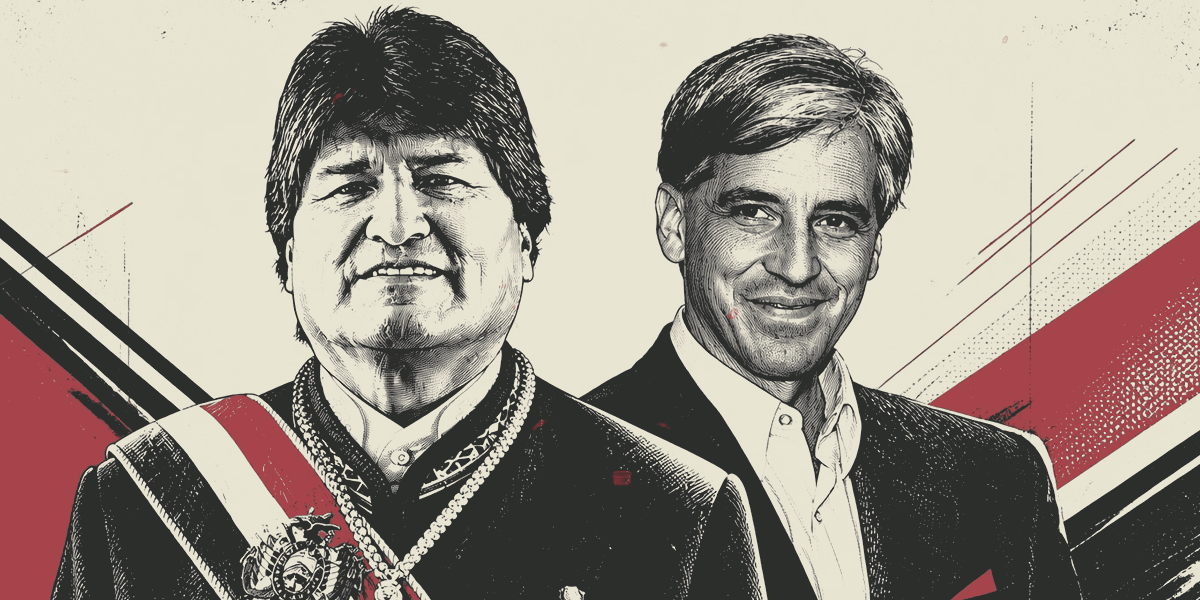
The Bolivian authorities said the shootout was part of an operation targeting members of a terrorist group that had been planning to assassinate Evo Morales and seeking to separate the Santa Cruz region from the rest of the country. The operation had been personally authorised by the president.
In 2020, after Morales had left office, the country’s new authorities acknowledged that the case had been politically motivated. The ex-president had used it to suppress the opposition in Santa Cruz.
The investigation into the Las Américas hotel case was initiated following a request from two right-wing lawmakers, Tomasa Yarhui and Rodrigo Antonio. The investigation is still at a preliminary stage. Prosecutors intend to gather evidence of Morales and García Linera’s alleged involvement before bringing formal charges against them.
EVO MORALES’ TRIALS AND TRIBULATIONS
The investigation into the long-running Las Américas hotel case is not the first attempt to bring Morales to justice. Even before the Prosecutor General’s announcement, several arrest warrants had already been issued against the former Bolivian president.
One of them was issued quite recently, on July 30. The authorities brought six charges against the politician, including terrorism and armed rebellion. The case stems from 53 days of mass protests that swept across the country in May and June. Bolivia’s Prosecutor General’s Office concluded that Morales had incited his supporters to blockade roads and protest against the government. According to the Bolivian government, the unrest resulted in 22 deaths.
The previous arrest warrant dates back to May. It was issued because Morales had repeatedly ignored court summonses. He was consequently declared a fugitive and banned from leaving the country. The court hearings he had been summoned to attend, however, concerned an entirely different case involving human trafficking and the sexual exploitation of a minor.
According to investigators, Morales had a relationship with 15-year-old Cindy Sarai Vargas Pozo in 2015-2016. The girl was allegedly “sold” to the president by her own parents in exchange for political favours, which is why the alleged offence was classified as human trafficking. The girl herself refused to identify as a victim and repeatedly called for the case to be dropped. The Bolivian law enforcement authorities, however, insisted on pursuing it. The preliminary investigation into the Cindy Sarai Vargas Pozo case began in 2020 and developed into a full criminal case in 2024. That same year, the Bolivian authorities issued another arrest warrant for Morales and arrested the girl’s father, while she herself went into hiding.
Finally, the fourth arrest warrant in total (the first one chronologically) was issued against the former Bolivian president in 2019, shortly after his ouster. The country’s interim government also accused him of rebellion and terrorism, alleging that he had planned to blockade roads and cut off food supplies to major cities. In October 2020, however, a court revoked the warrant, citing a violation of Morales’s right to a defence. The other three warrants remain unenforced.
THE STUDENT AND THE MENTOR
Evo Morales’s legal troubles did not emerge out of nowhere. They are closely linked to Bolivia’s political situation following the former president’s departure from office. Morales resigned in 2019 under pressure from mass protests over the disputed results of the presidential election, in which he had declared himself the winner.
After being forced to resign, Morales fled to Mexico and then Argentina. Power in Bolivia passed to his ideological opponents, the right-wing Democratic Unity party led by Jeanine Áñez, who had served as the second vice president of the Bolivian Senate. It was under her government that attempts were made to charge Morales with rebellion and his alleged involvement with minors.
The political alliance between Arce and Morales, the student and the mentor, did not last long. The former president sought to retain control over domestic politics and regarded Arce merely as a temporary figure meant to pave the way for his own return to power. Arce, meanwhile, was determined to establish his own authority and refused to fall in line with his predecessor.
By 2023, the Movement for Socialism party had split decisively into two factions: the “Evistas”, who remained loyal to Morales and insisted that he alone had the right to run for president, and the “Arcistas”, who rallied around the incumbent president. The rift deepened after Bolivia’s Plurinational Constitutional Court issued a precedent-setting ruling that no citizen could serve as president for more than two terms, whether consecutive or non-consecutive. The decision effectively barred Morales from standing in future presidential elections. Against the backdrop of the split, the Arce government also began reviving the criminal cases against the former president. In 2025, Morales formally broke with the socialist party and launched his own political project.
Another twist in the drama came in 2025, when centrist-right politician Rodrigo Paz Pereira won the presidential election. One of the new Bolivian leader’s first moves was to dismantle the power structure built by the Movement for Socialism. Luis Arce is now in custody on corruption charges, while the criminal proceedings against Morales have expanded and gathered pace.
THE CHAPARE FORTRESS
Despite the numerous criminal cases against him and his physical presence in Bolivia, the country’s authorities have been unable to get their hands on the ex-president. As early as 2024, Morales took refuge in Chapare, a remote tropical region whose inhabitants remain loyal to the country’s former leader. Over the past two years, his supporters have built a multilayered defence system around his sanctuary at Lauca Ñ, consisting of six concentric rings guarded by thousands of armed loyalists.
Morales’s allies regularly organise large-scale blockades of the country’s key highways and threaten the central authorities with a full-scale uprising should they attempt to arrest Morales. By December 2024, the Bolivian Prosecutor General’s Office had acknowledged the existence of “organised resistance” and “significant technical and operational risks” that made an arrest impossible.
Despite his deep hostility towards Morales, Bolivia’s current president, Rodrigo Paz Pereira, is also unwilling to provoke a civil conflict. His argument is that any armed operation in Chapare would inevitably result in casualties, for which the government would be held responsible. Arresting Morales could shatter the country’s fragile balance of power. For Paz, who came to power on a promise of stability, that would be a catastrophe.
The conflict surrounding Evo Morales has thus reached a stalemate. The Bolivian government cannot arrest him because of the numerous risks involved. At the same time, continuing criminal proceedings against him in the absence of the principal defendant is exceedingly difficult. Conversely, the more charges brought against Morales, the harder it becomes for him to compel the central government to make concessions.
For Bolivia, the Evo Morales case has become a point at which the personal ambitions of political leaders intersect with questions about the resilience of state institutions. With the arrest warrants still unenforced and Morales entrenched in his stronghold, the country is searching for answers about the future of its democracy, the independence of its courts and the rule of law. Whether Bolivia can emerge from this downward spiral through peaceful constitutional means or will sink into even deeper fragmentation remains the key question for the months ahead.
Vitaly Ryumshin
Image credit: "Za rubejom", Leonardo.ai
An interview with Olga Veretennikova, Vice President of the Borsell analytical firm
Since the Soviet era, hundreds of thousands of Africans have studied in Russia, including future presidents and prime ministers. The new Russian-African Youth Union aims to carry this tradition forward and take it to a new level.

Over the past six months, the EU–MERCOSUR agreement has helped boost trade, but a dispute over Brazilian meat has once again set the partners against each other.
How Britain’s welfare system turned into a trap for both the public purse and the people it is meant to help.
Some cities gain new shops and hotels after a film comes out; others lose residents and introduce visitor limits. Here’s what fame really costs.
The reasons why the EU has to change the rules before admitting new members.